Terra Nova
Here's something from the Southern Hemisphere for those in snowbound Northern regions.

In the grainy film, three white Siberian ponies struggle up a glacier hauling heavy sledges. The air is thick with wind-whipped snow, the visibility not more than a few metres. The ponies sink hock deep with every stride, pushing off their hindquarters and plunging their front legs like broken ski poles as they attempt to gain purchase on the unreliable terrain. It is epic and, like most sagas, tragic. Dogs pull sledges, too, scrawny and underfed, but lighter on their feet than the ponies, more agile over the snow. They are hungry, watchful, and ready to pounce should a pony go down.
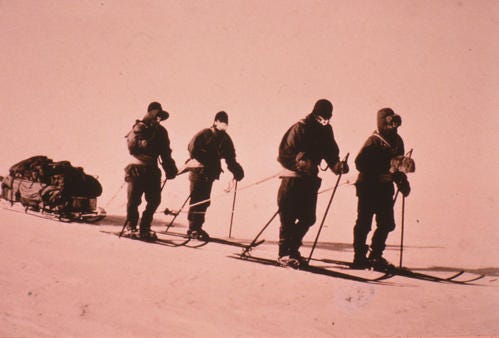
Men also strain against the icy grade, “manhauling” another heavy sledge. Four of the men wear thin Nordic skis and haul themselves forward with spindly poles, the sledge attached to canvas yokes the men wear like cummerbunds. The fifth man, in boots that resemble bundles of rags, lunges like a drunkard beside a pony. This man is Oates. He is charged with care of the ponies, has argued against their use and for their welfare. He has purchased with his own money and smuggled aboard two extra tons of fodder and does his best. For Britain and empire. The music swells heroically.
We are watching Scott of the Antarctic on a dreary winter evening. Produced in 1948 at Ealing Studios and starring John Mills, the film cleaves to the ‘Scott as hero’ school of history. Shot in Technicolor (largely wasted on the bleak grey and white terrain, the glaciers and blizzards and the shaggy white ponies); only the faces of the principal actors are ruddy and vivid in startling contrast to the vast, monochromatic landscape.
John Mills claimed that it was “jolly satisfying to help bring the great story of British enterprise and grit to the screen.”1 During the making of the film, Mills wore Scott’s watch which had been recovered and presented to his widow, even though Scott’s body was inexplicably left on the ice. The film paints the expedition’s tragedies and failures with a light brush. There was a Royal Command Performance, and the film was a box office sensation in beleaguered post-war Britain.
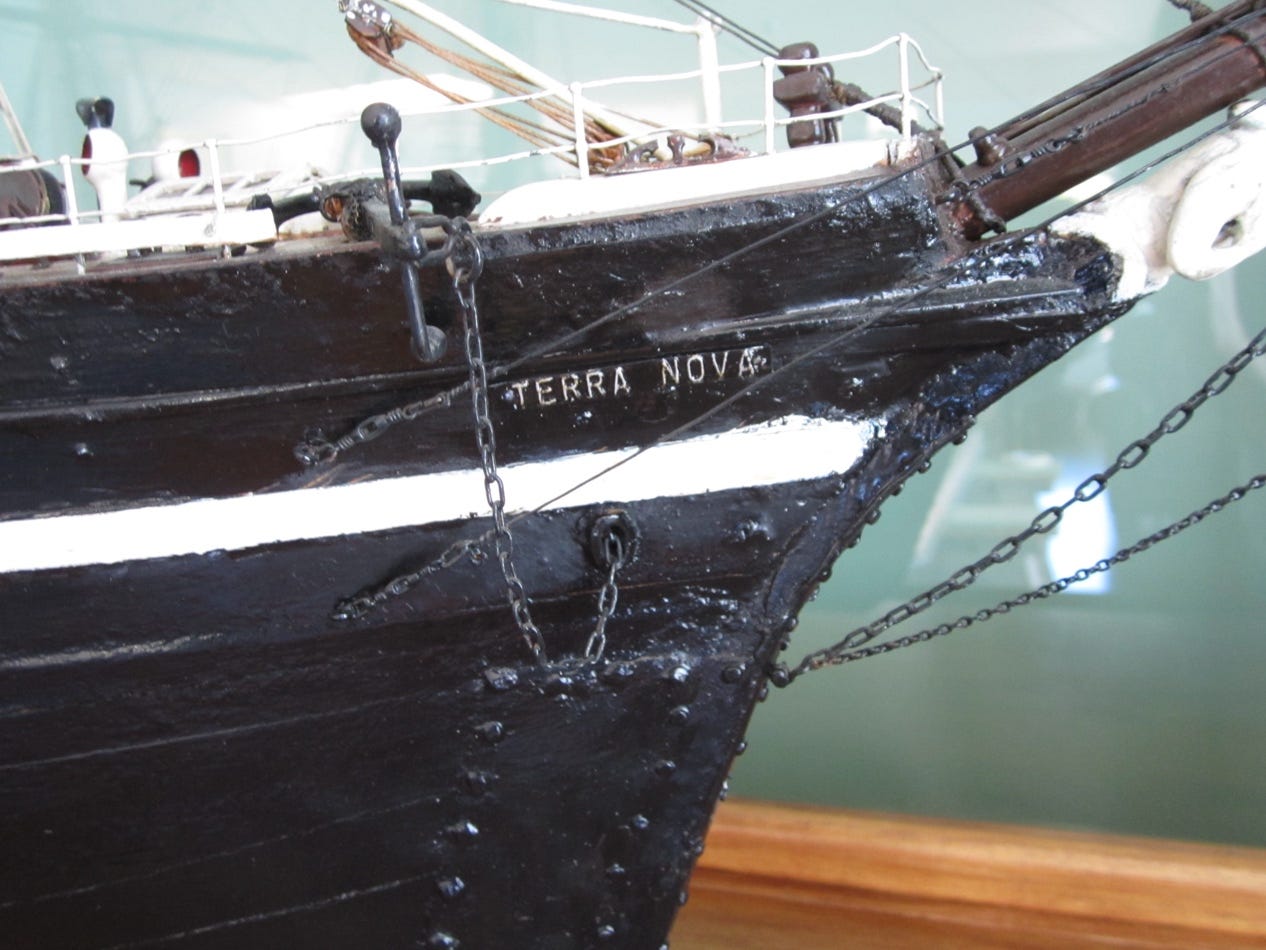
In a glass cabinet in our living room, we have a 1/42nd working scale model of the Terra Nova, the ship that Robert Falcon Scott sailed to Antarctica in his ill-fated attempt to be the first to reach the South Pole, to claim glory for Britain. The model Terra Nova was built in the 1930’s by former crewman Edward A. “Mac” McKenzie, to mark the 25thanniversary of the expedition. It was later used to create the special effects for the Ealing Studios film. Mac was just a lad in 1910; he’d lied about his age to join the Royal Navy and gained a place as lead stoker below decks on the much-vaunted British Antarctic Expedition. According to a typewritten description of its provenance, the model Terra Nova was a labour of love for the ex-crewman; the three-masted, single funneled replica is complete with rigging, compound steam engine and lifeboats. The detail is accurate right down to the ship’s black cat, no bigger than my thumbnail. She sits primly on the rear deck, tail curled around her haunches.
We found the Terra Nova at the back of an antiquarian bookshop in London. It was dusty and in need of some minor restoration but priced to sell and came with an ugly Perspex case suitable for shipping. We knew the Terra Nova had New Zealand connections. When she embarked from the port of Lyttelton on November 26, 1910, throngs of enthusiastic New Zealanders crowded the wharf to farewell the explorers. And when she returned on February 10, 1913, carrying only the surviving crew and weary scientists, the Terra Nova anchored outside the port of Oamaru so that the grim news of Scott’s death could be carried quietly to shore.
Our own New Zealand connections were fresh and new. We’d read a bit about Scott’s expedition and its fraught history, seen photos of the excited crowds when the Expedition set sail from these shores. We’d pored over Herbert Ponting’s haunting black and white photos of the crew, the dogs and ponies, the Terra Nova stuck in the pack ice. But we, too, were giddy; ours a new-found allegiance to an adopted homeland. Impulsively, we bought the ship and brought her home.
Lawrence “Titus” Oates served in a cavalry regiment in the Second Boer War. He paid a thousand pounds to join Scott’s expedition as horse master, only to discover that unsuitable ponies had already been purchased. Scott believed that white ponies were stronger than darker ones (an opinion with no basis in fact) and had secured the 19 grey Siberian ponies for a pittance (money for the expedition was famously tight). Scott’s agent, hamstrung by the order for white ponies, scoured a Manchurian market. The shaggy grey beasts delivered to New Zealand to await the voyage South were all he could find; some were old, most unfit, and several not even broken to harness. Oates protested at the state of the ponies, but the pushback from Scott was immediate and unyielding. A cavalry officer is bound by duty to his commander and regiment, but his first duty of care is to his horses. Oates resigned himself to it and cared for the ponies as a good soldier must.
What those ponies endured is hard to comprehend. Two died in a storm at sea before reaching Antarctica. Another was set upon by the hungry dogs. Four ponies became stranded on an ice floe and were soon surrounded by a pod of orca “poking their heads out of the water … their eyes trained on the ponies … spooking the ponies until they toppled into the water. Oates and Bowers tried to pull them to safety, but they proved too heavy. One pony survived by swimming to thicker ice. Bowers finished off the rest with a pickaxe so the orcas at least wouldn’t eat them alive.”2
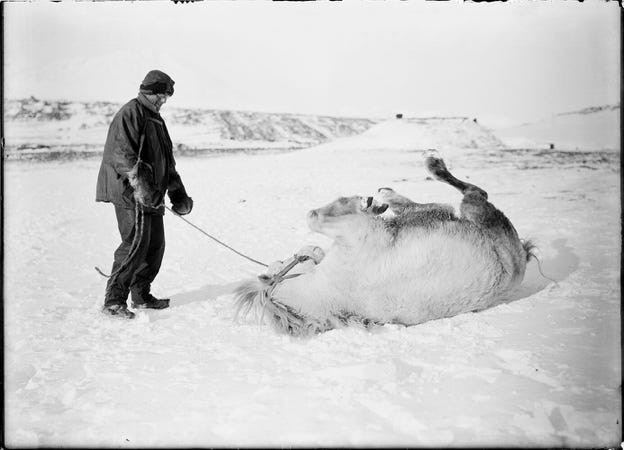
Oates was a soldier and a scholar. His letters home to his mother were candid, insightful, and strident in opinion. He gave lectures to the crew on proper horse management and assigned the ponies, each to its own handler. Oates kept for himself the stroppy, ill-tempered Christopher who wouldn’t accept the harness without a fight. Some of the men grew quite fond of their charges, giving them titbits and sorrowing at their privations. Ponting’s photographs capture both the hardship and the intimacy. “There is Cherry-Garrard with his pony, Michael, of whom he said, ‘Life is a constant source of wonder to him.’ Michael is rolling on his back in the snow. Cherry-Garrard holds him on a long rein.”3
Throughout the expedition, Oates advocated for better treatment. He begged to cull the weaker ponies to put an end to their miseries. After the punishing foray deep into the interior, hauling sledges to provision supply depots on route to the pole, the few remaining ponies were butchered for food. The dog team turned back and just five men, hand-picked by Scott, slogged on by foot. Oates, no longer shackled with care of ponies, was chosen to take part in the final press.
After gaining the Pole and the bitter disappointment of finding Amundsen’s flag already flying there, after the death of Edgar Evans who suffered gangrene from a cut and fell over in the snow and died, four of the five original party members were left huddled in a tent in a white-out blizzard, “a scene of whirling drift”, their food supplies nearly exhausted.4 Oates asked the others to go on without him. He was suffering from an old war wound, his feet gangrenous from frostbite. When they refused him, Oates simply walked out of the tent into the raging blizzard without even his boots, choosing the path an animal will choose: to drop behind and let the herd, the pack, the party flourish without the weight of a sick and dying member. “I am just going outside,” he told them, “and may be some time.”5
It’s a shame I can’t see what’s below deck on the model Terra Nova. I believe that Mac would’ve detailed the ship’s interior as completely as the exterior and I try to imagine what he left there just below deck. As stoker, his life on the voyage was lived largely below. He would’ve been intimate with the ponies whose rudimentary stables on the voyage were no more than crates built into the sidewalls. I like to imagine those little boxes below deck, a tiny white pony placed in each one along with some coils of fine dry grass to mimic the fodder Oates had smuggled aboard. The truth is the ponies stood knee-deep in their own excrement by the time they arrived on the Southern Continent. It’s remarkable they could walk at all.
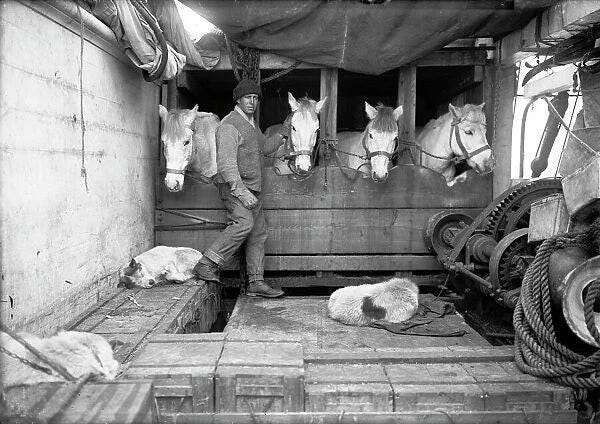
Photo credits:
“Members of Scott’s party manhauling a sledge” ©Antarctica New Zealand Pictorial Collection
“Terra Nova”, detail of model in the author’s collection.
Ponting, Herbert (1870-1935), “Apsley Cherry-Garrard with the pony ‘Michael’ in the Ross Dependency of Antarctica, during Captain Robert Falcon Scott’s Terra Nova Expedition to the Antarctic, October 1911.” @Getty Images Gallery.
Ponting, Herbert (1870-1935), “Capt. Oates and some of the ponies on the Terra Nova, 1910”. British Antarctic Expedition 1910-13. Collection of Scott Polar Research Institute, University of Cambridge.
Notes:
1. “The Starry Way: John Mills Grows Beard for Epic Role of Scott”, The Courier Mail, Queensland, Australia. 5 June 1948, 2.
2. King, G. (2012) “Sacrifice Amid the Ice: Facing Facts on the Scott Expedition,” Smithsonian Magazine, 16 May 2012.
3. Manhire, B. (2016) “Ponies,” from The Stories of Bill Manhire (Wellington: Victoria University Press).
4. Ibid.
5. King, G. (2012).
That vividly brought to life the realities of an expedition I only knew the headline details about. How crazy it is when humans want to achieve something at the expense of common sense and other beings, when that something isn't really that important. Yes society somehow buys into it, and the idea of a heroic adventure is passed down through generations. Great writing Abby, this honours the true heroes of the expedition x
Such a well-written and cold (in a few ways) story.